
- Loan or cash: closer than you think
- Deciding how much car
- The charges at the dealership
- If you take the loan
- Frequently asked questions
- Is it better to buy a car with cash or a loan?
- How much should I spend on a car?
- Why is the final price higher than advertised?
- Which dealer charges can I refuse?
- Should I buy new or used?
- What should I do when the loan is closed?
- In short
The question people ask is whether to finance a car or pay cash. The question that matters far more is how much car to buy, because that decision is worth several times whatever the financing choice is worth.
Still, both are worth working out, and the financing answer is more surprising than it looks.
Loan or cash: closer than you think
Take a car with an on-road price of twelve lakh rupees. A loan of ten lakh at nine and a half per cent over five years produces an EMI of about ₹21,000, and total interest of about ₹2.6 lakh.
That ₹2.6 lakh looks like the cost of financing, which is why people conclude that paying cash is obviously better. But the cash buyer has given up twelve lakh rupees that could have been invested, so the comparison has to be done properly.
Pay cash. Twelve lakh gone. No EMI, so the ₹21,000 a month is free to invest. Over five years at eleven per cent, that monthly investment grows to about ₹16.85 lakh.
Take the loan. Pay two lakh down, keep ten lakh invested, service the EMI from income. Over five years the ten lakh at eleven per cent grows to about ₹16.85 lakh, and the loan is repaid.
Almost exactly the same. Which makes sense: when the loan rate is close to what your investments earn after tax, the two paths are near-equivalent. Nine and a half per cent borrowed against eleven per cent earned, less tax on the gains, comes out as a wash.
So the arithmetic does not decide it. Three other things do:
Liquidity. The loan route keeps ten lakh available. For someone without a large cushion, that flexibility has real value, and the modest cost of the loan is the price of it.
Discipline. The cash route only wins if the ₹21,000 is genuinely invested every month. If it gets absorbed into spending, the cash buyer ends with a car and nothing else, while the loan buyer ends with a car and the untouched investment.
Certainty. The loan rate is fixed; the investment return is not. A conservative person is right to prefer having no debt.
And if the loan rate is well above what your investments realistically earn — anything in the teens — the comparison tilts clearly towards cash.
Deciding how much car

This is the consequential decision, and the answer most people do not want.
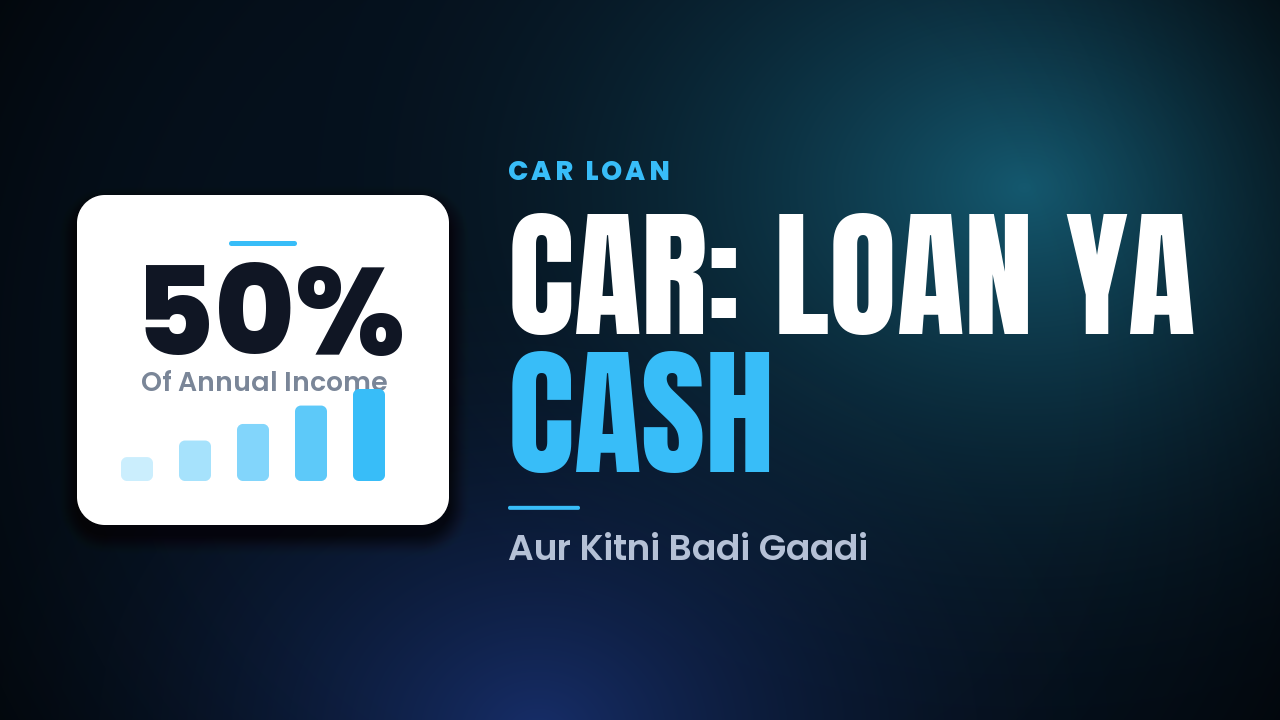
Keep the on-road price under about half your annual income. A conservative ceiling that leaves room for everything else. Someone earning fifteen lakh a year buying a fifteen lakh car has committed a year of income to a depreciating asset.
Keep the EMI under about ten per cent of take-home pay, and remember that the EMI is not the cost — running the car is. Fuel, servicing, insurance renewal, tyres, parking and the occasional repair commonly add as much again. Budget the total, not the instalment.
Budget the on-road price, not the ex-showroom price. Registration, road tax, insurance and various dealer charges commonly add a tenth or more to the advertised figure. People finalise a car on the ex-showroom price and are short at delivery.
Keep the emergency fund intact. A car is never a reason to empty it.
Consider a used car seriously. A car loses a substantial share of its value in the first three years, and buying a well-maintained three-year-old vehicle transfers that loss to the first owner. The same money buys a considerably better car, and the warranty question is usually addressable through an extended warranty or a certified pre-owned programme.
The strongest financial decision in this whole subject is usually to buy one segment below what you could afford, or to buy used. Neither is a popular recommendation.
The charges at the dealership

Ask for the on-road price fully itemised, in writing, before paying anything. Several line items are dealer revenue rather than statutory charges.
Statutory and unavoidable: the ex-showroom price, GST and cess as applicable, road tax, registration charges, and any state-specific levy.
Negotiable or refusable:
- Handling, logistics or transportation charges. Not statutory. Consumer forums have repeatedly held these to be unjustified where the vehicle was simply delivered to the dealership in the normal course. Ask for them to be removed.
- Dealer-arranged insurance. You are free to buy your own policy, and it is usually cheaper with better terms. Dealers earn commission on this and will push back; the choice is legally yours.
- Accessory packages. Mats, seat covers, mud flaps, a camera — priced far above what the same items cost separately. Decline the package and buy what you want later.
- Extended warranty. Sometimes genuinely worth it on a car you will keep beyond the standard warranty, and often overpriced. Compare the cost against a realistic estimate of out-of-warranty repairs, and buy it later if it can be added before the warranty expires.
- Paint protection and anti-rust treatments. Very high margin, questionable value.
- Registration assistance and documentation fees, which should be nominal.
Also check the manufacturing date of the specific vehicle. A car manufactured ten months ago is a year older on paper, depreciates from that date, and should be discounted accordingly.
If you take the loan
- Compare the rate across your own bank, two others and the dealer’s finance arm. Dealer finance is convenient and frequently more expensive, and the dealer earns on arranging it.
- Ask whether the rate is flat or reducing. A flat rate is roughly double the equivalent reducing rate. On car loans this is still encountered.
- Get the total interest over the tenure, not just the EMI.
- Keep the tenure short — three to five years. A seven-year car loan means owing money on a vehicle worth far less than the balance.
- Put down as much as you comfortably can without touching the emergency fund.
- Check the foreclosure charge before signing, since car loans commonly carry one.
- Decline bundled insurance and accessories financed into the loan, which means paying interest on them for five years.
- On closure, collect the no-dues certificate and get the hypothecation removed from the registration certificate. This last step is routinely forgotten and causes a problem when you sell.
Frequently asked questions
Is it better to buy a car with cash or a loan?
At a loan rate close to what your investments earn after tax, the two are nearly equivalent. Choose the loan for liquidity, cash for certainty — and cash clearly if the rate is in the teens.
How much should I spend on a car?
On-road price under about half your annual income, with an EMI under about ten per cent of take-home pay, remembering that running costs add as much again.
Why is the final price higher than advertised?
The advertised figure is ex-showroom. Registration, road tax, insurance and dealer charges commonly add a tenth or more. Budget the on-road price.
Which dealer charges can I refuse?
Handling or logistics charges are not statutory and are worth challenging. You can also buy your own insurance and decline accessory packages, paint protection and bundled extras.
Should I buy new or used?
A car loses a large share of its value in the first three years. A well-maintained three-year-old vehicle transfers that loss to the first owner, and the same money buys a better car.
What should I do when the loan is closed?
Collect the no-dues certificate and get the hypothecation removed from the registration certificate — the step people forget until they try to sell.
In short
Financing versus cash is close to a wash when the loan rate is near what your investments earn after tax, so decide it on liquidity, on whether you would actually invest the cash you kept, and on your own comfort with debt — and pay cash if the rate is in the teens.
The decision that matters is how much car: on-road price under about half your annual income, EMI under about ten per cent of take-home, with running costs budgeted at roughly as much again as the EMI, the emergency fund untouched, and a serious look at a three-year-old vehicle that has already taken the steepest depreciation. Then demand the on-road price fully itemised before paying anything, refuse handling charges, buy your own insurance, decline the accessory package — and if you finance, keep the tenure to five years, compare rates beyond the dealer’s own arm, and get the hypothecation removed when it closes.
यह भी पढ़िए: Car Loans in India: The Dealer Finance Trap and How to Avoid It · Buying a Used Car in India: The Checks That Save You Lakhs · Car Insurance in India: IDV, Zero Depreciation and the Claims That Fail






