
- Start with the honest arithmetic
- What sells
- How the money works
- Exclusive or everywhere
- What actually drives discovery
- Production, properly
- The money that goes the wrong way
- Frequently asked questions
- How much do self-published books typically earn?
- What is the biggest avoidable loss for an Indian author?
- Why does pricing affect my royalty so much?
- What matters most for getting discovered?
- Should I take the exclusivity programme?
- Can I pay for reviews to get started?
- In short
A software engineer spends fourteen months writing a novel, publishes it, tells friends and family, and sells sixty-one copies — forty of them in the first week, to people he knows. The book is competently written. Nobody who does not know him will ever encounter it.
This is the ordinary outcome, and it is not because the book is bad. Self-publishing is a discovery problem wearing the costume of a writing problem, and the things that fix it are mostly not writing.
Royalty rates, royalty bands, programme terms, tax forms and platform policies change. Verify every rate and rule on the platform itself before relying on anything here.
Start with the honest arithmetic
The large majority of self-published titles sell in the tens or low hundreds of copies and earn less than the author spent on the cover. That is the base rate, and any account of this business that does not open with it is selling something.
What distinguishes the minority that earn is fairly consistent: they are in a category where readers actively search for solutions or for more of a genre they already read; they have professional covers; they are findable through the right keywords and categories; and there are several of them by the same author. One book is a leaflet. A series or a shelf is a business.
So the useful question is not “will my book sell” but “am I building the kind of thing that sells, in the kind of category where it sells”.
What sells
- Non-fiction solving a specific, searchable problem. Not “a guide to productivity” but something a person types into a search box at eleven at night. The narrower and more urgent, the better.
- Genre fiction in series. Romance, thrillers, cosy mysteries, fantasy — categories where readers consume many books and will buy book two the day they finish book one. The series is the mechanism; a standalone genre novel is far harder.
- Professional and skills material for a defined audience — a practical manual for a trade, a profession, a software tool, a certification.
- Regional language writing. Genuinely underserved. The ebook market in Indian languages is much smaller than in English and so is the competition, and readers do look for it. If you write well in Tamil, Marathi, Bengali, Malayalam or Hindi, this is a real opening rather than a consolation.
- Short, practical non-fiction, which sells perfectly well at modest length when it delivers what the title promises.
What generally does not sell: literary fiction without a readership already in place; poetry; memoirs by people who are not known; a book about a topic with no search demand; and anything whose audience is “everyone”.
One caution: exam and study material is a crowded, heavily policed space. Do not reproduce syllabi, question papers, or other publishers’ content. Original explanation and original practice material are fine; copied material gets the listing removed and can expose you to worse.
How the money works
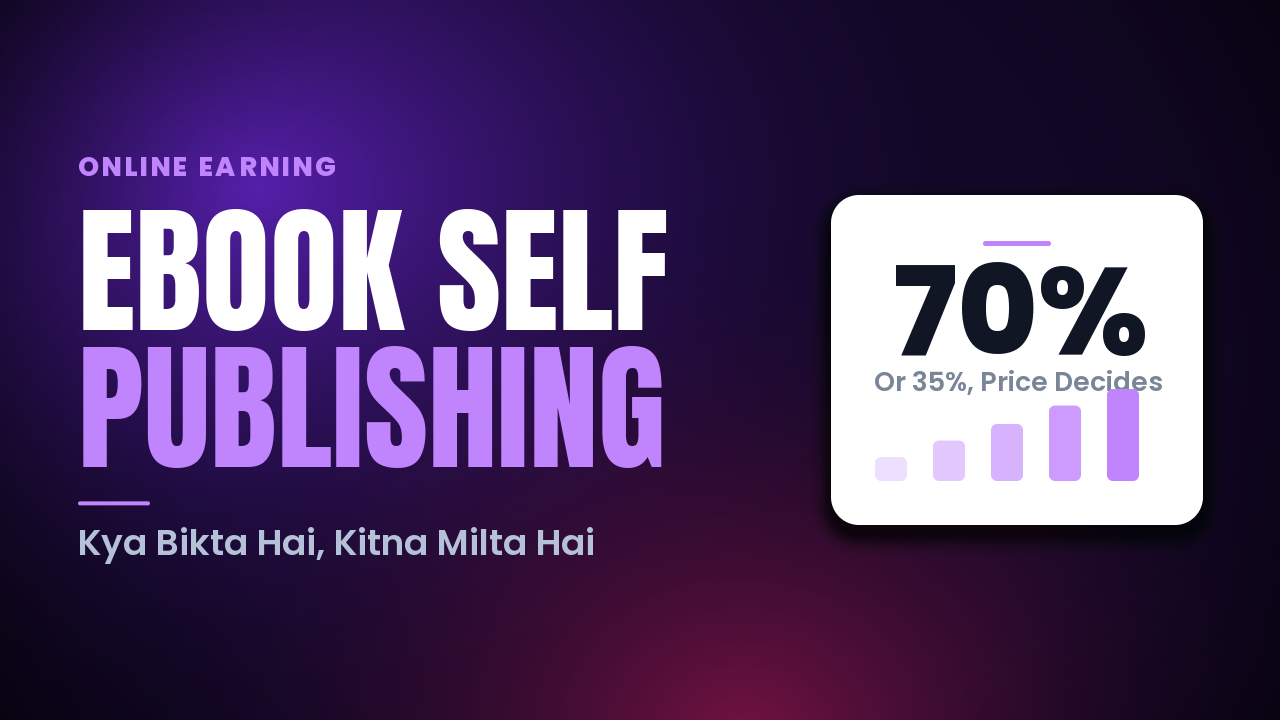
Ebook royalties are typically paid at one of two rates — a higher rate for books priced inside a specified band, and a substantially lower one outside it. The higher tier also deducts a delivery charge based on file size, so a book stuffed with large images earns less per sale. Print-on-demand paperbacks pay a percentage after printing cost, which is a thinner margin but adds a format readers still want.
Three things determine what you actually receive:
Price the book inside the higher royalty band. This sounds obvious and is routinely got wrong, particularly by authors pricing very low to attract readers. Below the band, your royalty rate halves.
Where your readers are matters enormously. Indian store price points are low, so the absolute royalty per sale is small — selling a hundred copies in India may earn less than ten copies abroad. If you want meaningful income, your book has to reach readers in higher-priced markets, which is a decision about subject, language and marketing rather than a lever you pull later.
File the tax form. This is the single largest avoidable loss for an Indian author. Royalties from a United States platform are subject to withholding tax, and the default rate is high. Completing the tax interview in your publishing account and declaring your Indian tax identification allows the lower treaty rate to apply. It takes ten minutes, and authors routinely discover years later that a large share of their earnings was withheld unnecessarily. Do it before the first sale. Confirm the current rate and procedure, since both change.
You still declare the income in India as business or professional income, and credit for tax withheld abroad is a matter to take an accountant’s view on.
Exclusive or everywhere
Platforms offer an exclusivity programme: commit the ebook to one store for a period, and in exchange your book enters a subscription lending library where you are paid from a shared fund according to pages read, plus some promotional tools.
The trade-off is real and genre-dependent. Fiction readers, particularly in romance and thriller categories, use subscription services heavily, and page-read income can exceed sales income for those authors. Non-fiction and professional titles often do better sold everywhere, including on platforms where the reader is a buyer rather than a subscriber.
If you are unsure, start exclusive for one term, measure what proportion of your earnings came from page reads, and decide with that number rather than with an opinion.
What actually drives discovery

The cover. First and most important, and the place where first-time authors save money they should not save. A reader’s decision happens in under a second at thumbnail size. Your cover has to signal the right genre instantly and look like the professional books in that category — which means studying the current bestsellers in your exact category and commissioning something that belongs beside them. Hire a designer who does book covers. This is the best money you will spend.
The title and subtitle. For non-fiction, the subtitle carries the searchable promise and should contain the words a reader would actually type. For fiction, the title signals genre and the cover does the rest.
Categories and keywords. You get a limited number of keyword slots and category placements, and they determine where your book can be found at all. Spend real time here: look at what readers search, choose categories specific enough that a modest number of sales ranks you visibly, and avoid the broadest categories where you will never appear. Request additional category placements where the platform allows it.
The sample. Readers read the opening pages before buying. Front-load the value — no long preface, no acknowledgements, no three-page explanation of why you wrote the book. Start where the reader’s interest starts.
Reviews, obtained honestly. Early reviews matter. Get them by giving advance copies to readers who will genuinely read the book and asking them to review honestly. Do not pay for reviews, do not swap reviews in organised groups, and do not use ranking or review services — these violate platform policy and get listings removed. The offers will reach you; decline them.
More books. The most reliable driver. A reader who finishes one of your books is the easiest sale you will ever make, and a back catalogue makes advertising economic because you earn across several titles rather than one.
Production, properly
- Get it edited. At minimum a copyedit by someone who is not you. For fiction, also a developmental read. Beta readers before that, for free, are the cheapest useful feedback there is.
- Format it cleanly. Free and inexpensive tools produce perfectly good ebook files. Keep the formatting simple — ebooks reflow, and elaborate layouts break.
- An ISBN is not required for an ebook on most platforms, which supply an identifier. For print you may want your own, and an Indian author can obtain ISBNs through the government agency that issues them.
- Add a print edition through print-on-demand once the ebook exists. It costs nothing to set up, adds credibility, and some readers only buy paper.
- Consider audio later, once the book has demonstrated it sells.
- Disclose AI-assisted content where the platform requires it. Policies on this are explicit and evolving, and misdeclaring is a straightforward way to lose the account.
The money that goes the wrong way

Vanity publishers. Companies charging authors lakhs for “publishing packages” — editing, cover, distribution, marketing — much of which the author could arrange for a fraction of the price, and some of which involves signing away rights for years. A legitimate publisher pays you; a service provider charges a defined fee for a defined service. Anything presenting itself as a publisher while charging you a large sum for the privilege of being published is the thing to walk away from.
Marketing packages with promised results. Guaranteed bestseller status, guaranteed review counts, guaranteed rankings. Either fabricated or policy-violating.
Paid reviews. Covered above. The risk is your listing, not just your money.
Over-investing before validation. Spend on a good cover and a copyedit. Hold the rest until the book shows signs of selling.
Frequently asked questions
How much do self-published books typically earn?
Most sell in the tens or low hundreds of copies and earn less than the author spent producing them. The ones that earn are usually in searchable non-fiction or series genre fiction, with professional covers, good keyword and category placement, and several titles by the same author.
What is the biggest avoidable loss for an Indian author?
Not completing the tax interview in the publishing account. Without it, royalties from a United States platform are withheld at a high default rate instead of the lower treaty rate, and authors often discover this years later.
Why does pricing affect my royalty so much?
Because the higher royalty rate applies only inside a specified price band. Priced below it, the rate roughly halves — which catches authors who price very low hoping to attract readers.
What matters most for getting discovered?
The cover, then the title and subtitle, then categories and keywords, then the opening sample. Writing quality decides whether readers finish and recommend the book, not whether anyone finds it.
Should I take the exclusivity programme?
It depends on genre. Fiction readers use subscription services heavily, so page-read income can exceed sales income; non-fiction often does better sold everywhere. Try one term, measure what share of earnings came from page reads, then decide.
Can I pay for reviews to get started?
No. Paid reviews, review-swap groups and ranking services violate platform policy and get listings removed. Give advance copies to readers who will review honestly instead.
In short
Self-publishing is a discovery problem, not a writing problem. What sells is non-fiction answering a specific searchable question, genre fiction in a series, practical material for a defined profession, and writing in Indian languages where the competition is thin. What does not sell is a book whose audience is everyone.
Spend your money on a cover that belongs beside the bestsellers in your exact category and on a copyedit, and spend your time on the subtitle, the categories and the keyword slots, because those decide whether anyone ever sees the book. Front-load the sample, collect early reviews honestly and never pay for them, and understand that the second and third book are what make the first one earn. On the money: price inside the higher royalty band, remember that Indian store price points make the absolute royalty small so meaningful income needs readers abroad, and complete the tax interview with your Indian tax identification before the first sale — it takes ten minutes and is the largest avoidable loss in the whole business. Then decline the vanity publishers, the guaranteed-bestseller packages and the paid review services, all of which will find you.
यह भी पढ़िए: Selling Digital Products in India: The Audience Comes First · Content Writing as a Career in India: Rates, Clients and Specialising · Starting a Blog in India That Actually Earns






