
- Markup and margin
- Count all the costs, not just the purchase
- What a discount actually costs
- Raising prices without losing customers
- Which customers to look at
- A page you should be able to write
- Frequently asked questions
- What is the difference between markup and margin?
- How do I price for a target margin?
- What costs should go into the unit cost?
- What does a ten per cent discount really cost?
- Is it better to raise prices or chase volume?
- What number do most small business owners not know?
- In short
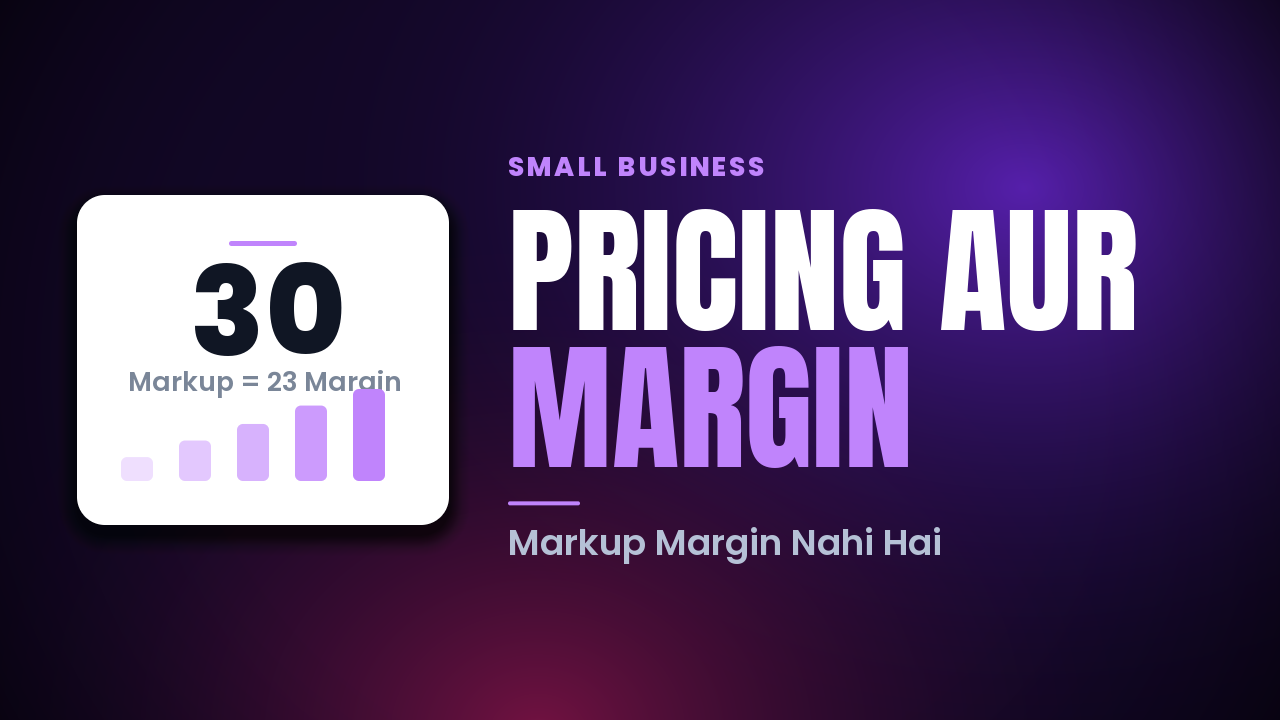
A shopkeeper buys at a hundred and sells at a hundred and thirty, and describes his margin as thirty per cent. It is twenty-three per cent. Thirty rupees on a selling price of a hundred and thirty is twenty-three per cent of what came in.
On a single sale that is a rounding difference. Across a year’s turnover it is a large sum, and it is the reason a business that believes it is comfortably profitable finds nothing left after rent and salaries.
This is the arithmetic, and then the two decisions it changes.
Markup and margin

Markup is measured on cost. Margin is measured on the selling price.
Buy at a hundred, sell at a hundred and thirty: the markup is thirty per cent of cost, the margin is twenty-three per cent of revenue. The higher the number, the wider the gap — a fifty per cent markup is a thirty-three per cent margin, and a hundred per cent markup is a fifty per cent margin.
To price for a target margin, divide rather than add. For a forty per cent margin on a cost of a hundred: divide by zero point six, giving a hundred and sixty-seven. Adding forty per cent would have given a hundred and forty, which is a twenty-nine per cent margin — and the eleven-point gap repeats on every sale for as long as the pricing stands.
Write the formula on the wall of the shop: price equals cost divided by one minus the margin you want.
Count all the costs, not just the purchase
The second error is treating the purchase price as the cost. The cost of a unit sold includes:
- The purchase price, net of any discount actually received.
- Freight and handling to get it to you.
- Wastage, breakage, spoilage and theft, as a percentage of what you buy. A grocery or a bakery with a real wastage rate and no provision for it in the price is selling at a loss on the good units to pay for the bad.
- Packaging for the sale.
- Payment costs — card fees, platform fees, a share for a delivery aggregator. These come out of the margin and are frequently ignored at the pricing stage.
- Returns, where you take them.
And then the costs that are not per unit but have to be covered by the total margin: rent, salaries, electricity, internet, licences, interest on borrowing, the accountant, and your own time if the business is to pay you a salary rather than a leftover.
A simple discipline: work out the monthly total of fixed costs, divide by the average margin per sale, and you have the number of sales a month at which the business breaks even. Most small business owners have never computed that number, and it is the single most useful figure they could have.
What a discount actually costs

This is the arithmetic that changes behaviour.
Suppose your margin is thirty per cent. Offer a ten per cent discount, and the discount comes entirely out of the margin — so the margin falls from thirty to twenty, which is a third of the profit on that sale gone.
To earn the same total profit, you now need to sell half again as many units. Not ten per cent more. Half again.
Work out your own version of that sentence before offering a discount, and the conversation about festival offers changes considerably. Most shopkeepers who do this once stop discounting and start adding something instead — a free delivery, an extra service, a longer warranty, a small complementary item whose cost is a fraction of the discount they were about to give.
Three related points:
A free item is a hundred per cent discount on that unit’s margin. Buy-one-get-one on a thirty per cent margin is sold below cost.
Discounting trains customers to wait. A shop that discounts every festival has customers who buy only at festivals, which is a permanent reduction in the full-price business rather than a temporary promotion.
Raising prices beats raising volume on arithmetic, because extra volume carries extra cost — more stock, more staff, more space — while a price increase carries almost none. A five per cent price rise on a thirty per cent margin raises profit on each sale by a sixth, with no additional cost at all.
Raising prices without losing customers
- Raise them in small steps, regularly, rather than in a large jump every four years. An annual adjustment is noticed less and is also honest, since your own costs rise annually.
- Raise with a reason, stated plainly if asked — input costs, a better product, a service added.
- Change something at the same time. A new size, a better packaging, an added service. A customer compares the new price against the old one unless there is something new to compare it against.
- Keep one visible item unchanged, which is the one customers anchor on and remember.
- Tell regular customers in advance as a courtesy, which costs nothing and is received well.
- Accept that you will lose a few. The customers who leave over five per cent are the ones who were costing you the most attention, and the arithmetic usually favours the trade.
- Do not apologise for it. A price explained confidently is accepted; a price apologised for invites negotiation.
Which customers to look at
Two more pieces of arithmetic worth doing once.
Margin by product, not just overall. Most small businesses have a handful of lines carrying the margin and a long tail carrying almost none, and they do not know which is which. List your products with their actual margin per unit and the volume sold, and the picture is usually surprising — the item you are proudest of may be subsidising the one you ignore.
Cost to serve, by customer. A customer who negotiates every order, needs three visits, pays late and returns items is less profitable than a smaller customer who pays on time and asks for nothing. Businesses pursue the first because the invoice is larger. Count the time, and some large customers turn out to be the problem rather than the prize.
A practical consequence for anyone selling on credit: a late payer at a thirty per cent margin who pays ninety days late has consumed your working capital, which has a cost. Build payment terms and a small early-payment incentive into the price rather than absorbing the delay silently.
A page you should be able to write
- Your average margin percentage, computed on selling price.
- Your monthly fixed costs.
- The monthly sales at which you break even.
- Your three highest-margin products and your three lowest.
- The extra volume a ten per cent discount would require.
- The date you last raised prices.
If any of those six is unknown, that is the first thing to work out — before any marketing, any new product or any expansion, all of which amplify whatever the current arithmetic is.
Frequently asked questions
What is the difference between markup and margin?
Markup is measured on cost and margin on the selling price. Buying at a hundred and selling at a hundred and thirty is a thirty per cent markup and a twenty-three per cent margin, and confusing the two means under-pricing for years.
How do I price for a target margin?
Divide rather than add: price equals cost divided by one minus the margin you want. For a forty per cent margin on a cost of a hundred, divide by zero point six to get a hundred and sixty-seven — adding forty per cent would give a twenty-nine per cent margin.
What costs should go into the unit cost?
Purchase price net of discounts, freight, wastage and breakage as a percentage, packaging, card and platform fees, and returns. Then cover rent, salaries, power, licences, interest and your own salary from the total margin.
What does a ten per cent discount really cost?
On a thirty per cent margin it takes a third of the profit on that sale, so you must sell half again as many units simply to stand still. Work out your own version of that before offering any discount.
Is it better to raise prices or chase volume?
Raise prices, because extra volume brings extra stock, staff and space costs while a price rise brings almost none. A five per cent increase on a thirty per cent margin raises the profit on each sale by about a sixth at no additional cost.
What number do most small business owners not know?
Their break-even — monthly fixed costs divided by the average margin per sale. It is the single most useful figure in the business and it takes an hour to compute.
In short
Markup is on cost and margin is on the selling price, so adding thirty per cent to cost gives a twenty-three per cent margin — and to price for a target margin you divide by one minus that margin rather than adding it. Write that formula down, because the gap repeats on every sale for as long as the pricing stands.
Then count the real cost: purchase price, freight, wastage, packaging, card and platform fees and returns — and cover rent, salaries, power and your own salary from the total margin. Compute the break-even: monthly fixed costs divided by average margin per sale. Most owners have never worked that out and nothing else in the business can be judged without it.
Finally, do the discount arithmetic before the festival rather than after. Ten per cent off a thirty per cent margin requires half again the volume to stand still, and a free item is a hundred per cent discount on that unit. Add value instead of cutting price, raise prices in small annual steps with something changed alongside, and look at margin by product and cost to serve by customer — because the line you are proudest of may be subsidising the one you ignore.
यह भी पढ़िए: Keeping Customers: The Cheapest Growth a Small Business Has · Registering a Small Business in India: Which Structure and Which Licences · GST Composition Scheme: Simpler, and It Closes Three Doors






