
- The flat rate trap
- Before you sign
- Get the on-road price broken down
- Arrange finance before you choose the bike
- Down payment and tenure
- Buy insurance yourself
- What lenders check
- Fees and clauses to read
- Is the loan worth taking at all?
- Comparing offers properly
- Frequently asked questions
- How much down payment is required?
- Can I get a loan without income proof?
- Is it better to use a credit card EMI instead?
- Does the loan affect my credit score?
- What if I want to sell the bike before the loan ends?
- Is an electric two-wheeler financed differently?
- In short
A two-wheeler loan is small enough that most buyers do not scrutinise it, which is precisely why it is often the most expensive borrowing they do relative to the amount. The interest rate quoted in a showroom is frequently not the rate you are actually paying.
The flat rate trap

This is the one thing worth understanding before anything else.
A reducing balance rate charges interest on what you still owe. As you repay, the principal falls and so does the interest. This is how home loans, car loans and most bank lending works.
A flat rate charges interest on the original amount for the whole tenure, regardless of how much you have repaid. In the final month, when you owe almost nothing, you are still paying interest as if you owed the full amount.
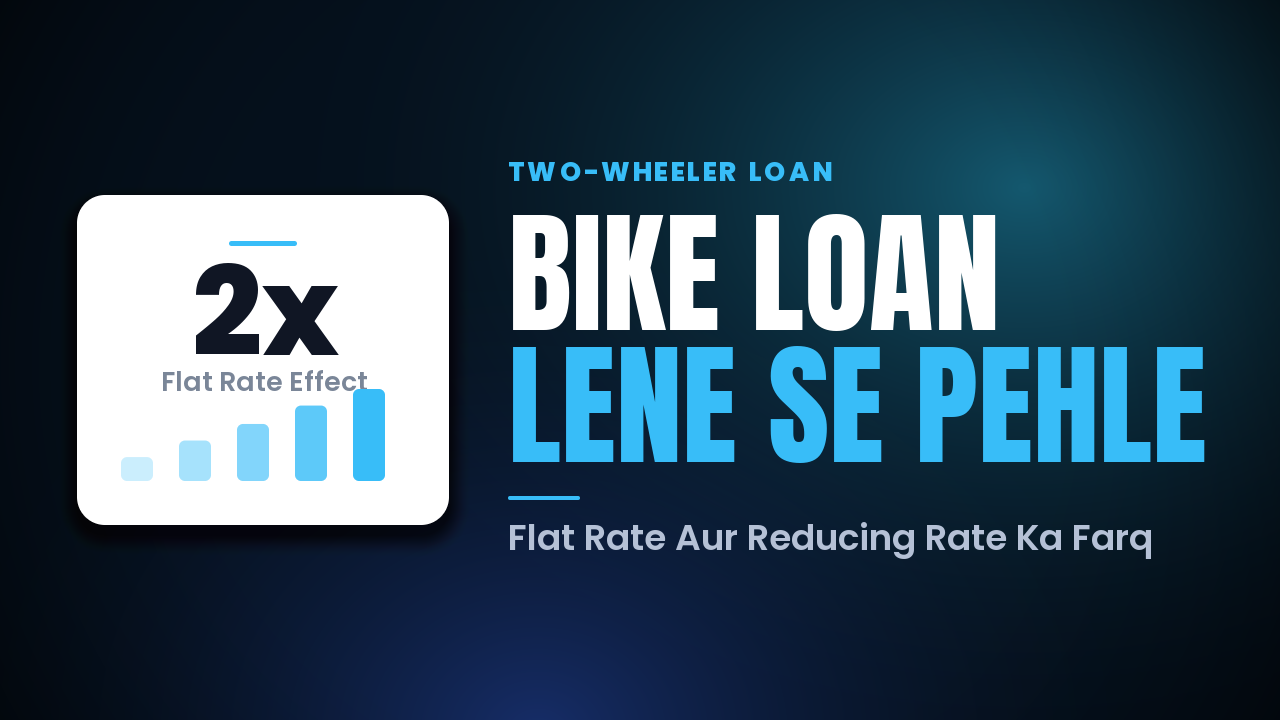
The effect is close to doubling. A loan quoted at “12 per cent flat” costs roughly 21 to 22 per cent on a reducing basis. Two-wheeler and consumer durable finance is where flat quoting persists most, because the absolute rupee amounts look small.
So the first question in any showroom is: is that rate flat or reducing? Then ask for the total amount repayable over the tenure, in writing. That single number removes every ambiguity.
Before you sign

Get the on-road price broken down
Ask for each line separately:
- Ex-showroom price
- Road tax and registration
- Insurance — and note that a new two-wheeler requires long-term third-party cover by regulation, which is a substantial one-time amount
- Handling or logistics charges — frequently negotiable, sometimes refundable
- Accessories — marked up heavily, and almost always optional
- Extended warranty or service package — optional
The discount gets advertised on the ex-showroom price; the padding sits in the other lines.
Arrange finance before you choose the bike
Dealers earn a commission on finance, which is why the conversation moves to EMI before the price is settled. Walk in with an alternative:
- Ask your own bank, where a salary account often brings a concession.
- Ask one NBFC that specialises in two-wheeler finance.
- Then let the dealer try to beat it. Sometimes they can, because manufacturers subsidise finance on slower-moving models.
Down payment and tenure
- At least 20 per cent down. Zero-down-payment schemes mean you owe more than the vehicle is worth from the first day, and the interest cost is higher.
- Three years maximum. Five-year two-wheeler loans exist and the extra interest on a small principal is disproportionate — by the end you may have paid a sizeable fraction of the bike’s price again.
Buy insurance yourself
Dealer insurance is convenient and usually costlier, and when it is financed into the loan you pay interest on it for the whole tenure. Compare online, buy it separately, and add own damage cover rather than only the mandatory third-party policy — a two-wheeler is far more likely to be damaged or stolen than written off.
What lenders check
Two-wheeler loans are among the easier loans to get, and they are not automatic:
- Credit score. A thin or damaged file leads to a higher rate or a larger down payment demand. Check it before applying.
- Income proof. Salary slips and bank statements, or ITR for the self-employed. Some NBFCs lend against lighter documentation at higher rates.
- Address stability. A long-standing address helps more than people expect for small-ticket lending.
- Existing obligations. Total EMIs against monthly income.
For a first-time borrower with no credit history, a two-wheeler loan repaid on time is a useful way to build a record — which is worth more later than the bike itself.
Fees and clauses to read
- Processing fee, often deducted from the disbursal.
- Documentation and stamp charges.
- Prepayment or foreclosure charges. Two-wheeler loans are usually fixed-rate, so these can apply. If you expect to repay early, check this before signing.
- Late payment penalty and whether it compounds.
- Hypothecation. The lender’s name is endorsed on the RC. When the loan closes, collect the no-objection certificate and get the hypothecation removed — forgetting this blocks a future sale and is a common and avoidable nuisance.
- Bundled loan insurance, frequently added and rarely mandatory. Ask in writing.
Is the loan worth taking at all?
On a small amount, the honest answer is often no.
A two-wheeler costing a modest amount, financed over three years at an effective rate above 20 per cent, can cost a significant premium over the cash price. If you can save for four to six months and buy outright, you will pay noticeably less.
The loan makes sense when the vehicle is needed now for income — a job you cannot reach, deliveries you cannot make — in which case the cost of waiting exceeds the cost of borrowing. That is a real and common situation; it is simply worth naming rather than assuming.
Comparing offers properly
Ask every lender for the same three numbers, for the same amount and tenure:
- The rate, explicitly on a reducing balance basis.
- The total of all fees.
- The total amount repayable.
Compare only the third. A lower rate with a higher fee can cost more, and an EMI quoted on a longer tenure will always look better while costing substantially more.
Frequently asked questions
How much down payment is required?
Lenders may finance most of the on-road price, and 20 per cent or more down is the sensible choice — lower interest, smaller EMI, no negative equity.
Can I get a loan without income proof?
Some NBFCs lend with lighter documentation at a higher rate and a larger down payment. Compare the total cost before accepting it.
Is it better to use a credit card EMI instead?
Usually no. Card EMI rates plus processing fees are generally higher than a two-wheeler loan, and it consumes your card limit.
Does the loan affect my credit score?
Repaid on time, it helps — particularly for a first-time borrower. Missed EMIs damage it and the lender can repossess the vehicle.
What if I want to sell the bike before the loan ends?
Clear the loan first, obtain the no-objection certificate, and remove the hypothecation from the RC. A buyer cannot register a vehicle with an active hypothecation.
Is an electric two-wheeler financed differently?
Terms are broadly similar, and some lenders offer concessions for electric vehicles, and subsidy schemes vary by state and change often. Ask specifically and verify the current scheme.
In short
Ask whether the quoted rate is flat or reducing — a flat 12 per cent is roughly 21 per cent reducing, and two-wheeler finance is where flat quoting still happens. Then compare lenders only on the total amount repayable.
Get the on-road price broken down and challenge handling charges and accessories, arrange finance from your own bank before visiting the showroom, put at least 20 per cent down, keep the tenure to three years, buy insurance separately with own-damage cover, and remove the hypothecation from the RC once the loan closes.
यह भी पढ़िए: Two Wheeler Insurance in India: What the Cheap Policy Leaves Out · Car Loans in India: The Dealer Finance Trap and How to Avoid It · How to Improve Your CIBIL Score in India: What Actually Moves It






