
- Why a withdrawal plan beats a dividend option
- How much can be withdrawn
- The risk that ruins it
- Setting it up
- The things that go wrong
- Frequently asked questions
- Why is a withdrawal plan better than a dividend option?
- How much can I withdraw each year?
- What is the biggest risk?
- How do I protect against that?
- Should I use this instead of an annuity?
- What should I do in a year when markets fall?
- In short
A retiree with a corpus needs it to produce a monthly income. The usual options are a deposit’s interest, a fund’s dividend option, an annuity, or a systematic withdrawal plan — selling a fixed amount of units each month.
The withdrawal plan is the most tax-efficient and the most flexible of them, and the one that can run out. Understanding both halves of that is the whole subject.
Tax rules and rates referred to here have been revised more than once. Confirm the current treatment before relying on any figure.
Why a withdrawal plan beats a dividend option

The tax arithmetic is the clearest argument.
A fund’s income distribution option pays you an amount that is fully taxable at your slab rate. Every rupee received is income.
A withdrawal, by contrast, is a redemption of units — and a redemption is part capital and part gain. Only the gain portion is taxed, as a capital gain, at capital gains rates rather than your slab. In the early years the gain portion of each withdrawal is small, so the tax is small.
For a retiree with other income, the difference over a decade is substantial. And the withdrawal plan lets you control the amount, which a distribution does not.
Against an annuity, the comparison is different: a withdrawal plan keeps the capital, keeps the flexibility, and keeps the possibility of running out. An annuity surrenders the capital, surrenders the flexibility, and removes the possibility of running out. Those are genuinely different products, and most retirees need some of each.
How much can be withdrawn
The number that matters, and the one people get wrong by a wide margin.
A corpus can sustain a withdrawal rate roughly equal to its real return — the return after inflation — indefinitely. Withdraw more and the capital erodes; withdraw less and it grows.
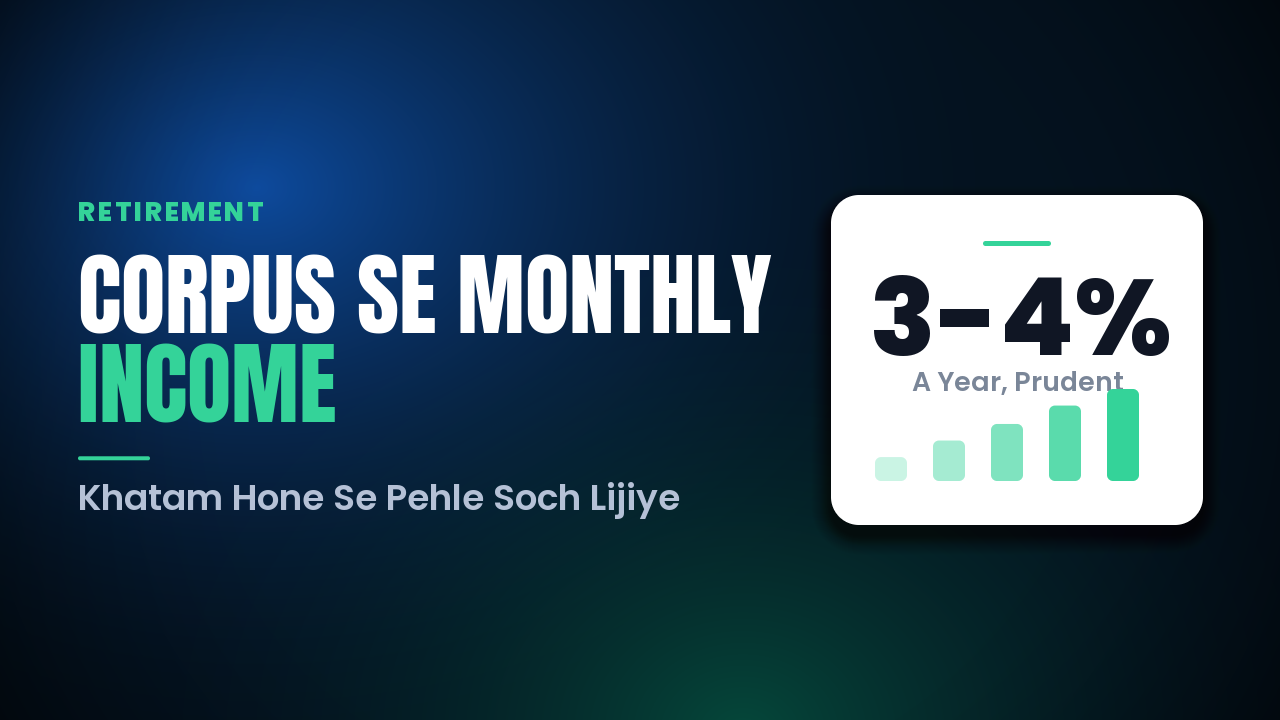
For India, where inflation has historically run higher than in developed markets, a prudent starting withdrawal rate is in the region of three to four per cent of the corpus a year, increased each year for inflation.
Which produces an uncomfortable arithmetic that is worth stating plainly: a corpus of one crore sustains something like three to four lakh a year, or twenty-five to thirty-three thousand rupees a month, rising with inflation — not the eight or ten per cent that people often assume.
If the required income is higher than that, the honest options are a larger corpus, a lower income, working longer, or accepting that the money will be consumed within a defined period — which can be a perfectly reasonable plan for someone at seventy-five, and is not for someone at sixty.
The risk that ruins it

Two retirees with identical corpuses and identical average returns can end up in completely different positions, depending on when the bad years fall. This is the single most important thing to understand about drawing an income from investments.
If markets fall in the first three years while you are withdrawing, each withdrawal sells units at a low price. The number of units falls faster than it otherwise would, and when the market recovers there is less left to recover. The corpus never catches up.
The same fall in year fifteen, after years of growth, does far less damage.
So the structure matters more than the fund selection. A bucket approach handles it:
- Two to three years of withdrawals in cash and short-term debt. A savings account, a liquid fund, short-duration funds, a deposit. This is what you actually withdraw from, and it does not fall when markets do.
- The next five to seven years in debt and conservative hybrid funds. Moderate risk, refilling the first bucket.
- The remainder in equity, left alone, to provide the growth that keeps pace with twenty-five years of inflation.
- Refill the first bucket from the third in good years, rather than mechanically every month. In a bad year, do not sell equity at all — live off the first two buckets and wait.
That last instruction is the whole point of the structure. It converts a market fall from a permanent loss into a delay.
Setting it up
- Work out your essential monthly expenses separately from discretionary ones. The essential figure is what has to be covered reliably.
- Cover the essential figure with guaranteed income where you can — a pension, an annuity, deposit interest. That removes the possibility of the floor failing.
- Use the withdrawal plan for the rest, from the bucket structure above.
- Set the withdrawal at three to four per cent of the corpus annually, and review it each year.
- Keep the withdrawal date after your other income arrives, so you are not drawing more than needed.
- Check the exit load on the funds you withdraw from, and set the plan to begin after any load period.
- Keep records of every withdrawal for tax, since each is a redemption with a gain to compute. Most platforms provide a capital gains statement.
- Review annually — increase the withdrawal for inflation, refill the buckets, and if the corpus has fallen substantially, reduce the withdrawal for a year rather than continuing mechanically.
The things that go wrong
- Withdrawing too much. The commonest failure. Eight per cent feels reasonable and exhausts a corpus in well under two decades.
- Withdrawing from pure equity. Which exposes every monthly withdrawal to the market’s mood.
- Not increasing for inflation, so the income quietly halves in purchasing power over fifteen years.
- Increasing it after a good year. A rising corpus is a buffer against the bad years, not a windfall.
- Continuing mechanically through a crash. The bucket structure exists precisely so you do not have to.
- Holding everything in debt, which feels safe and loses to inflation over a twenty-five year retirement.
- No medical buffer. A hospital bill met by redeeming equity in a bad month is how corpuses get damaged. Keep health insurance with a super top-up, and a separate medical reserve.
- Nobody else knowing the arrangement. Write down what is held where, and tell your spouse and children.
Frequently asked questions
Why is a withdrawal plan better than a dividend option?
A distribution is fully taxable at your slab rate. A withdrawal is a redemption, so only the gain portion is taxed, at capital gains rates — and you control the amount.
How much can I withdraw each year?
Prudently, three to four per cent of the corpus, increased annually for inflation. A one crore corpus therefore supports roughly twenty-five to thirty-three thousand rupees a month, not the eight per cent people assume.
What is the biggest risk?
A market fall in the early years while withdrawals are running, which sells units cheaply and permanently reduces the corpus. The same fall later does far less damage.
How do I protect against that?
Keep two to three years of withdrawals in cash and short-term debt, the next several years in debt and conservative hybrid funds, and the rest in equity — and do not sell equity in a bad year.
Should I use this instead of an annuity?
Alongside it. Cover your essential expenses with guaranteed income — a pension or an annuity — and use the withdrawal plan for the rest, which keeps the capital and the flexibility.
What should I do in a year when markets fall?
Live off the first two buckets, do not sell equity, and consider reducing the withdrawal for that year rather than continuing mechanically.
In short
A systematic withdrawal plan is more tax-efficient than a fund’s income option — only the gain portion of each redemption is taxed rather than the whole amount at your slab — and more flexible than an annuity, at the cost of being able to run out.
Set the rate at three to four per cent of the corpus a year, increased for inflation, and accept the arithmetic that follows: a crore supports roughly twenty-five to thirty-three thousand rupees a month, not far more. Then structure it in buckets, because the risk is a market fall in the early years while withdrawals are running: two to three years of withdrawals in cash and short-term debt, the next several years in debt and conservative hybrids, the rest in equity left alone — and in a bad year, live off the first two buckets rather than selling equity. Cover your essential expenses with guaranteed income, keep health cover and a medical reserve separately, and review the whole thing once a year.
यह भी पढ़िए: Retirement Planning in India When There Is No Pension · Annuities: Buying an Income You Cannot Outlive · Senior Citizens Savings Scheme: Quarterly Income, Government Backed






