
- What it is
- Why it is attractive
- The limits that matter
- VPF against the alternatives
- Who should use it, and who should not
- Setting it up
- Frequently asked questions
- What is VPF?
- Is the interest tax-free?
- Is VPF better than PPF?
- Can I withdraw VPF when I want?
- Can I stop or reduce it mid-year?
- Should VPF be my whole savings plan?
- In short
Salaried people looking for a safe place to put money compare fixed deposits, debt funds, the public provident fund and small savings schemes, and routinely overlook the one option that is usually better than all of them and requires no action beyond a form at the payroll desk.
The voluntary provident fund is simply the ability to contribute more than the mandatory amount to your existing provident fund account. It earns the same declared rate, carries the same sovereign backing, and needs no new account.
Rates, limits and tax thresholds in this area are revised, so confirm the current figures before deciding amounts.
What it is
Your provident fund contribution is a fixed percentage of basic salary and dearness allowance, matched by your employer. VPF lets you contribute above that, up to the whole of your basic and dearness allowance if you wish.
Three things to be clear about:
The extra contribution is not matched. The employer’s contribution stays at the statutory level. VPF is your money alone.
It goes into the same account. No separate account, no separate statement, no additional paperwork. It appears as a larger employee contribution in your provident fund passbook.
It earns the same rate as the rest of your provident fund balance — the rate declared each year, which has consistently been higher than bank deposit rates and higher than most other risk-free options available to an individual.
Why it is attractive

The rate. For a risk-free, sovereign-backed instrument, it is generally the best available to a salaried person. Compare it against a bank fixed deposit after tax and the gap is substantial.
No market risk. The rate is declared rather than earned in a market, so there is no capital fluctuation. A debt mutual fund’s value moves with interest rates; this does not.
No credit risk. Unlike a company deposit or a credit-risk debt fund, there is no question of the issuer defaulting.
It is automatic. Deducted from salary before it reaches you, which is the single most effective savings mechanism there is. No monthly decision, no transfer to remember, no temptation.
It qualifies for the savings deduction within the shared annual limit, in the old tax regime — though for many people that limit is already consumed by the mandatory contribution alone, so treat this as incidental rather than as the reason.
No paperwork. A form to payroll, once.
The limits that matter

Interest on contributions above a threshold is taxable. This is the most important thing to know and the most commonly missed.
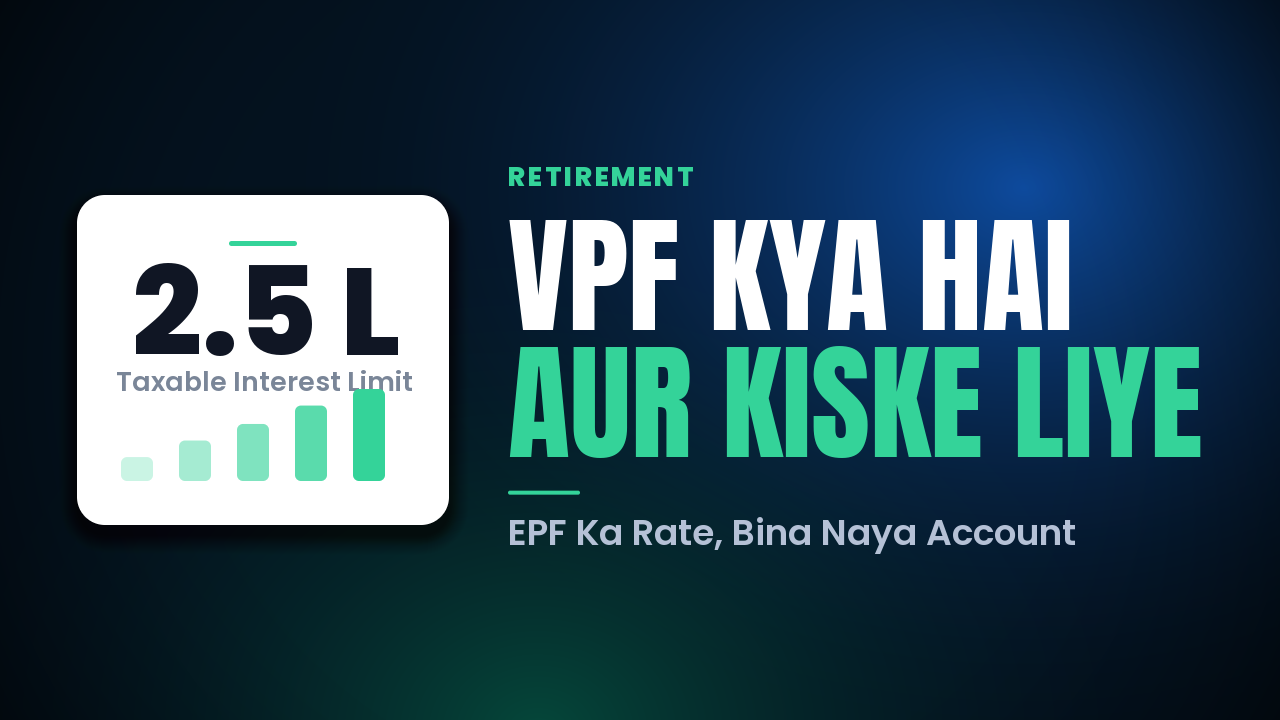
Interest earned on your own provident fund contributions beyond a specified annual amount is taxable in your hands, with a higher threshold applying where the employer makes no contribution to the fund. The tax is on the interest, not on the contribution, and the fund maintains separate taxable and non-taxable components to compute it.
The practical consequence: contribute up to the threshold freely, where the interest remains tax-exempt and the effective return is excellent. Beyond it, the interest is taxed at your slab rate, and the comparison against alternatives has to be made after tax rather than on the headline rate.
Note that the threshold applies to your total own contributions — mandatory plus voluntary — so work out the mandatory figure first and size the voluntary contribution within what remains.
It is locked until you leave employment. Partial withdrawal is permitted only for specified purposes — housing, medical treatment, children’s education and marriage, and similar — with their own conditions and limits. Money you might need next year should not go here.
It can usually be changed only once a year. Most employers allow the contribution percentage to be set or revised at the start of a financial year, not mid-year. Decide an amount you can sustain for twelve months.
It cannot generally be reduced at will. Check your employer’s policy, because committing a large proportion of basic salary and then needing to reverse it can be difficult.
It is debt. A portfolio consisting entirely of provident fund is a portfolio with no growth engine. Equity still has to come from somewhere else, and for a long horizon it should.
VPF against the alternatives
Against the public provident fund. VPF generally offers a higher rate, has no annual contribution cap of its own beyond your salary, and requires no separate account. PPF has a lower rate but a defined fifteen-year term with partial withdrawal later, is available to the self-employed and to those outside the provident fund system, and its interest is fully tax-free without the threshold VPF has.
A reasonable approach for a salaried person: use VPF up to the tax-free interest threshold, and PPF beyond that if more risk-free allocation is wanted.
Against a bank fixed deposit. VPF wins clearly on rate, and deposit interest is fully taxable at your slab in any case. The deposit wins on liquidity, which is the whole of its advantage.
Against a debt mutual fund. The fund offers liquidity and the possibility of capital gains when rates fall; it also carries interest rate risk and credit risk, and its returns are not assured. For money that simply needs to be safe, VPF is better.
Against the national pension system. NPS has lower costs, equity exposure and an additional tax deduction, and it imposes a compulsory annuity on exit with a taxable pension. VPF has no annuity requirement. They do different jobs.
Against equity. Not a comparison. VPF is the safe portion of a portfolio. Over twenty years it will not match equity returns and is not meant to.
Who should use it, and who should not
Use it if: you are salaried with a provident fund account; you want a risk-free allocation at a good rate; you have no equity gap to fill first; you are comfortable locking the money until you leave employment; and your total own contributions remain within or near the tax-free interest threshold.
Think again if: you have no emergency fund yet, which comes first and must be liquid; you are carrying high-interest debt, which outranks any investment; you have no equity exposure at all and a long horizon, in which case the growth gap is the bigger problem; you might change jobs or take a career break soon and want flexibility; or you are already at the taxable interest threshold, where the after-tax comparison may favour something else.
Setting it up
- Work out your current mandatory contribution from your payslip — the employee provident fund figure, annualised.
- Subtract it from the tax-free interest threshold to find the headroom available for voluntary contribution.
- Decide a percentage of basic salary that produces an amount within that headroom and that you can sustain for the whole year.
- Submit the request to payroll before the start of the financial year, in the format your employer requires.
- Verify it on your payslip the following month and in your provident fund passbook the following quarter.
- Check your nomination while you are there, since the provident fund nomination is one people frequently never complete or update after marriage.
- Review it annually, as salary changes move both the mandatory contribution and the headroom.
Frequently asked questions
What is VPF?
Contributing more than the mandatory amount to your existing provident fund account. It earns the same declared rate, needs no new account, and is not matched by the employer.
Is the interest tax-free?
Up to a threshold on your own total contributions. Interest on contributions above that is taxable at your slab rate, with a higher threshold where the employer does not contribute.
Is VPF better than PPF?
Generally a higher rate and no separate account. PPF’s interest is fully tax-free with no such threshold and it is available to the self-employed. Use VPF up to the threshold, then PPF.
Can I withdraw VPF when I want?
No. It is locked until you leave employment, with partial withdrawal allowed only for specified purposes. Do not put money here that you may need soon.
Can I stop or reduce it mid-year?
Usually not. Most employers allow changes only at the start of a financial year, so commit an amount you can sustain for twelve months.
Should VPF be my whole savings plan?
No. It is the debt portion. Equity for a long horizon has to come from elsewhere, and an emergency fund and clearing high-interest debt both come first.
In short
VPF gives you your provident fund’s rate — generally the best risk-free return available to a salaried person — with sovereign backing, no market or credit risk, no new account, and automatic deduction from salary, which is the most reliable savings mechanism there is.
Size it around the one real constraint: interest on your own total contributions above a specified annual threshold is taxable at your slab rate. Work out your mandatory contribution from your payslip, fill the remaining headroom with voluntary contribution, and compare anything beyond that against alternatives on an after-tax basis. Set it before the financial year begins, since it usually cannot be changed mid-year, and remember that it is locked until you leave employment. And treat it as the safe portion of a portfolio — after the emergency fund, after high-interest debt, and alongside rather than instead of equity.
यह भी पढ़िए: EPF Withdrawal in India: When It Is Taxed and Why Claims Get Stuck · PPF vs NPS: Which One Deserves Your Retirement Money · Section 80C: What Counts, What Does Not, and What to Actually Choose






